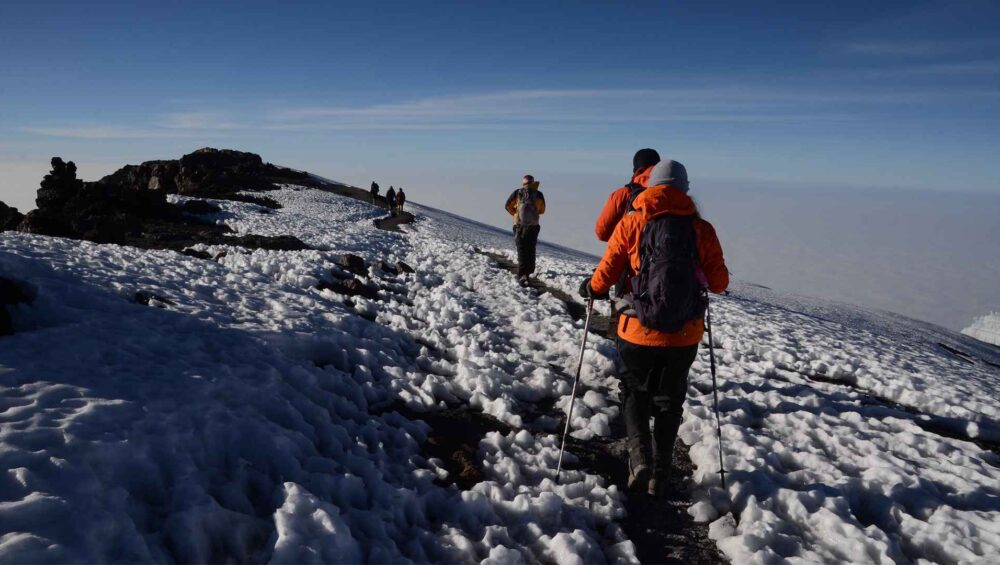
It takes five to nine days to climb Kilimanjaro, from bottom to the top and back down again.
To summit Mount Kilimanjaro, you need at least five days, but a minimum of six days is recommended for a better chance of reaching the top. Ideally, spending seven to eight days on the mountain greatly increases your success rate. For those with more time, several routes offer a more gradual ascent over ten days or more, providing a scenic and enriching experience.
Kilimanjaro, the world’s tallest free-standing mountain, rises nearly 5,900 meters (19,340 feet) above the plains of northeast Tanzania. This volcanic giant features snow-capped peaks and a dramatic Kibo Crater, despite its proximity to the equator

Route Options
- Marangu Route (5-6 Days): Known as the “Coca Cola Route” for its convenience and lower cost, this is the most popular route. It starts at Marangu Gate and includes overnight stays in huts at Mandara Hut, Horombo Hut, and Kibo Hut. The five-day trek returns to Horombo Hut on descent. For a safer and more enjoyable experience, consider the six-day version, which adds an extra night at Horombo Hut, allowing better acclimatization and a day to explore the Afro-alpine zone. However, it can be overcrowded, especially during peak seasons.
- Machame Route (6-7 Days): This route offers a more scenic and gradual ascent compared to Marangu, with nights spent at Machame Hut, Shira Hut, Barranco Camp, and Barafu Hut. It involves camping rather than staying in huts and is suitable for those wanting a more picturesque and less crowded experience. The seven-day, six-night option provides ample time for acclimatization.
- Shira Route (6-10 Days): Starting at Shira Gate, this route ascends the western flank of Kilimanjaro, merging with the Machame Route before the summit. It features a gradual ascent through unique Afro-alpine moorland and volcanic rock formations. The six-day trek is feasible, but adding extra days enhances acclimatization and the chance of spotting large mammals.
- Lemosho Route (6-10 Days): Known for its beauty, this route begins on the western slopes at a lower altitude, which helps in acclimatization. It starts in the forest zone and converges with the Shira Route. It can be completed in six days, but an eight to ten-day trek is recommended for a more gradual ascent and greater wildlife viewing opportunities.
- Northern Circuit (9-11 Days): This is the most remote and longest route, starting at Lemosho and looping around Kilimanjaro before summiting from the east. It offers the highest success rate due to its gradual ascent and extended acclimatization period. An optional extension includes a night in the Kibo Crater for a unique experience.
- Rongai Route (6-7 Days): The only route starting from the northern side, Rongai is less affected by rainfall, making it a good choice during the rainy season. It offers a gradual ascent and a chance to see large wildlife. The seven-day variation provides a higher success rate compared to the six-day trek.

Factors Affecting Climb Duration
- Altitude: The rapid gain in altitude is the biggest challenge. Acclimatization is key, so allocating extra days for the ascent is crucial. Climbing for over eight days significantly increases your chances of reaching the summit. Consider spending a few days at a mid-altitude location before starting your climb to further enhance acclimatization.
- Seasons: Climbing is best during the dry seasons from January to March and July to October. The rainy seasons (April to June and November to December) can make conditions more difficult. If you must climb during the rainy season, the Rongai Route is the driest option.
- Fitness: A reasonable level of fitness is required. Prepare by hiking in hilly terrain, running, or cycling to build endurance. Training hikes should be used to break in your boots and get accustomed to carrying a day pack.

Essential Gear
Kilimanjaro’s conditions can be varied: cold nights, intense sun, and potential rain. Essential items include:
- A windproof and waterproof jacket and trousers
- Warm, layered clothing
- Waterproof gloves
- Hiking boots and lighter shoes for evenings
- Trekking poles
- A four-season sleeping bag
- A waterproof bladder or water bottles with a 2L capacity
- A medical kit with painkillers, anti-inflammatories, blister plasters, sunblock, chapstick, and altitude sickness medication
- Energy-rich snacks like dried fruit, nuts, chocolate, and energy bars

Ready to Climb?
Explore and compare climbing, trekking, and hiking tours offered by top-rated operators to find the perfect Kilimanjaro adventure tailored to your needs and preferences